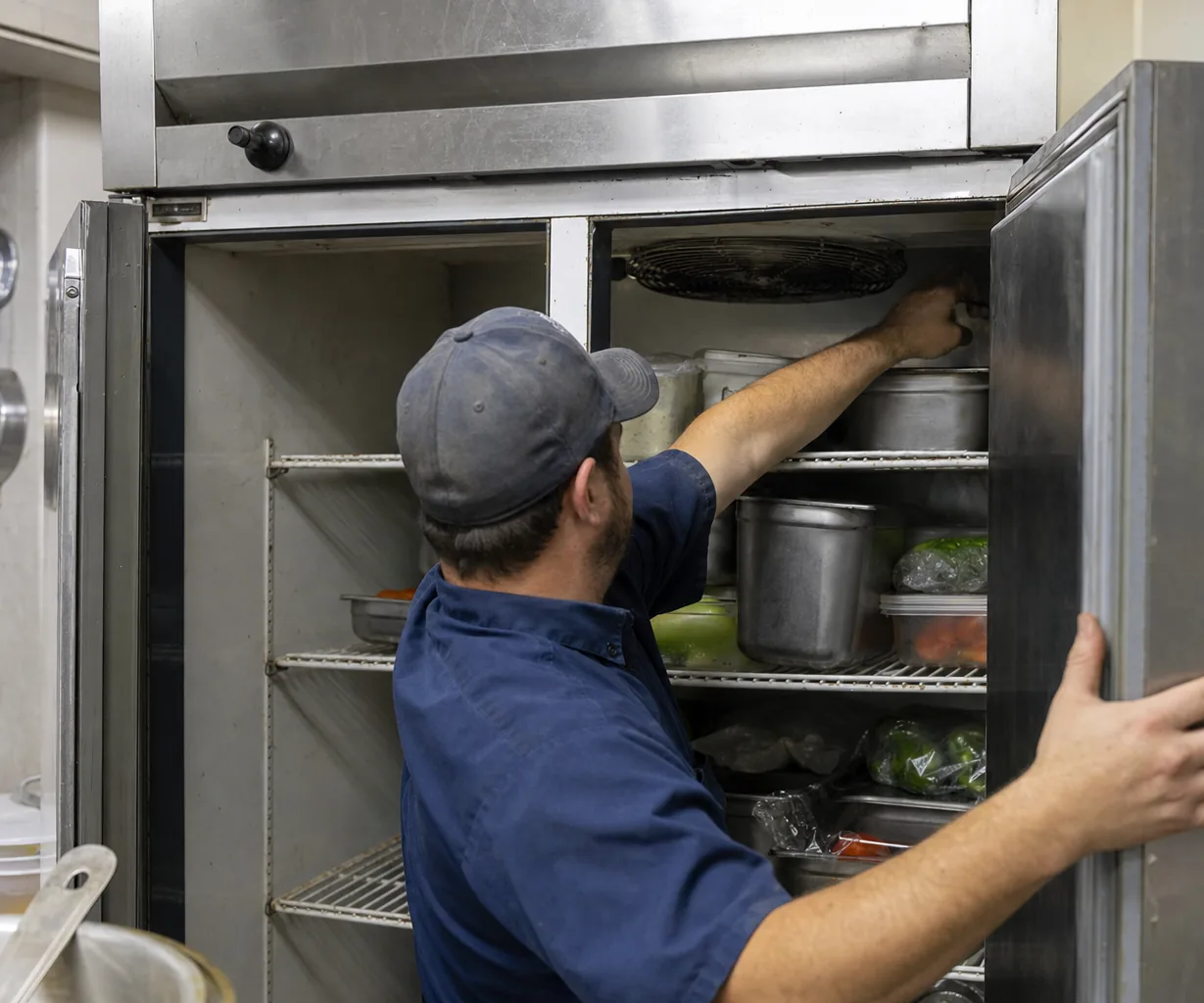
If you are hunting for the defrost timer on a Sub-Zero, the part may not exist. Electronic Sub-Zero built-ins hand that job to the control board, which starts each defrost on its own schedule, generally based on how long the compressor has run. A separate clockwork timer belongs to older units with mechanical controls. Either way, a coil packed with frost rarely means the timing alone has failed: the heater that melts the ice, the sensor that ends the cycle, the drain that carries the water off, or a door letting damp air in is the likelier culprit.
The pattern of the frost is the first clue. An even white coat across the freezer’s rear panel points at the defrost parts; crystals bunched near the door or on the food point at a seal.
How the defrost cycle works
A frost-free freezer pulls air across a very cold coil, the evaporator, and moisture in that air freezes onto its fins. Every so often the control pauses cooling and powers a small heater beside the coil until the frost melts. A thermostat or sensor clipped to the coil reports when it is clear, the heater shuts off, and cooling resumes. The water runs down a drain tube to a pan in the machine compartment, where condenser warmth evaporates it.
A refrigerator compartment runs above freezing, so its coil can often clear while the compressor rests. A freezer cannot, which is why frost trouble usually shows up there first.
Why frost builds up anyway
Frost needs moisture coming in and a defrost that cannot keep up. Orange Park sits between the St. Johns River and Doctors Lake, and indoor air here stays humid much of the year, so every door opening carries water vapor inside. A flattened gasket, a drawer propped open by an overfilled basket, or a door stopping a few millimetres short lets that air in around the clock.
On the defrost side, the heater can burn open so the coil never warms. The thermostat or sensor can misread and end the cycle early. The control board can stop calling for defrost, sometimes after an outage and the surge that follows. Or the drain can freeze, so meltwater turns into a sheet of ice on the compartment floor.
Once the coil is fully iced, air cannot pass, and the freezer warms while the compressor runs nonstop. On 600, 648PRO and 700 Series units that long run can bring up EC40 with Service flashing, which Sub-Zero links to excessive freezer compressor run, a door left ajar, or a fan, sensor or sealed-system fault.
What you can safely do
Start with the doors. Dark interior lights on a Classic (CL) or Designer (DET, DEC) unit can mean a door or drawer is ajar, since the unit cuts the lights to limit heat; Sub-Zero suggests shutting everything and waiting one hour before calling for service. Slide a sheet of paper into each closed door at the corners and tug it out. Loose paper means a gap where damp air gets in.
For heavy icing, a manual defrost buys time and tells you something. Move the food into coolers, switch the unit off and lay towels down. The Classic and Designer guides call for a hair dryer on low, kept moving; the PRO Series guide asks for a handheld steamer and rules out the hair dryer. When the coil is clear and dry, power back up. If thick frost returns within a few days, a defrost part has failed and the thaw only bought time.
Why chipping ice off is a mistake
A butter knife or ice pick is tempting. Resist it. The evaporator is thin tubing and fins carrying refrigerant, and one slip can pierce it. A pinhole lets the charge leak out, and a heater or sensor job becomes sealed-system work, the most expensive repair a built-in can need. Bent fins also choke the airflow. Gentle heat and patience are the only safe tools.
Reading the frost
| Symptom | Likely cause | What the owner can check | When to call a technician |
|---|---|---|---|
| Even frost over the rear panel | Heater, thermostat or sensor | Thaw it, watch for regrowth | Frost is back within days |
| Frost on food and near the door | Air slipping past a seal | Paper test, clear drawer tracks | Gasket torn or door will not seal |
| Ice sheet on the compartment floor | Frozen or blocked drain | Dry it, see whether it returns | Ice keeps forming in one spot |
| EC40 with Service flashing | Freezer compressor overworking | Clean the condenser if under 10° above set | More than 10° above set, doors shut |
What a defrost repair involves
A technician confirms the failed part before ordering anything: heater resistance, sensor readings, whether the board is calling for defrost, and whether the drain is open. Our $80 diagnostic covers that. As a typical range, a defrost heater, thermostat or sensor runs $260–$630, a control board $430–$810 and a door gasket $230–$610, with the firm price set after diagnosis. Sub-Zero recommends that a technician replace any torn gasket. More is on the frost and defrost page, and if the freezer has quit altogether, the freezer checklist works through the causes in order.