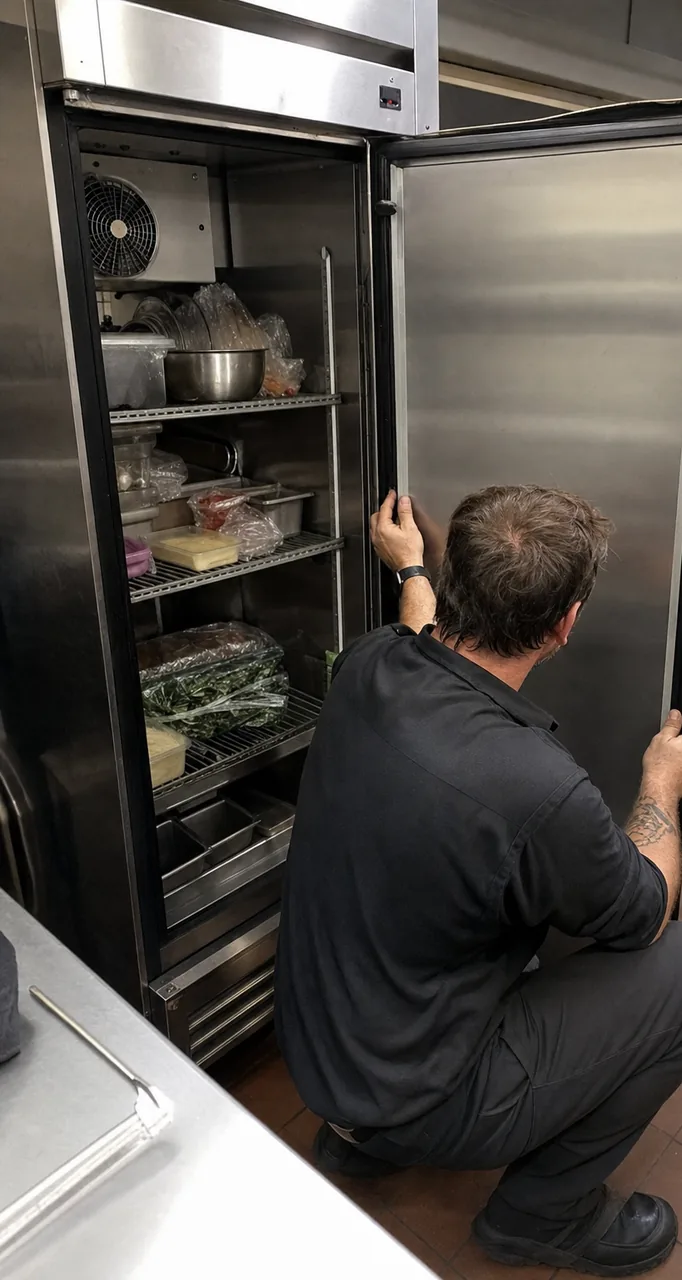
When a Sub-Zero freezer is not working, the cause usually sits between the door and the coil rather than in the compressor: a drawer that stops short, a gasket that no longer seals, a condenser choked with dust, or an evaporator buried in frost. Read the display, confirm the freezer is still set near 0°F, and look at the condenser behind the grille. Those three checks cost nothing and clear away the easy answers before anyone needs a meter.
If the refrigerator stays cold while the freezer softens, look at the freezer’s own machinery: many Sub-Zero built-ins give it a separate compressor, coil and fan.
Start with the display and the settings
Classic (CL) and Designer (DET, DEC) units ship set to 0°F for the freezer and 38°F for the refrigerator, adjustable a degree at a time. Their freezers only go from -5° to 5°F, so a reading in the teens is a fault, not a nudged setting.
Two display states are easy to misread. On a Classic (BI), Sh r stands for Showroom Mode, where lights and display work but nothing cools. To leave it, switch Power off, hold a Warmer and Colder pair of keys, press Power, then release all three. On current Classic and Designer models, a screen stuck on 38° and 0° with nothing inside cold may be that same demonstration setting, and Sub-Zero sends owners to its customer care line for it.
Doors, drawers and the gasket
Drawers are the usual offenders: an overfilled basket or a stray bag holds the front a few millimetres proud. Pull each drawer out, sweep spilled ice from the tracks, and push it home by hand to feel whether it seats.
Then test the seal. Shut the door or drawer on a sheet of paper at several spots around the frame and pull; you should feel drag every time. A strip that slides free, a torn corner, or a gasket flattened behind a heavy cabinet panel lets humid air inside, and through a Clay County summer that moisture turns to frost quickly. Seal and hinge repairs are covered on our door gasket page.
The condenser and the Service warnings
The condenser rejects the heat the freezer removes. Matted with lint, it makes the compressor run longer while temperatures still slip. Sub-Zero says a unit younger than 6 months does not need its condenser cleaned; on anything older, switch the unit off and vacuum the fins gently with a soft brush.
The control often announces this. A flashing Vacuum Condenser message means the unit is straining or running warm: clean the condenser, then power it back on to reset. When Service blinks between the zone readings and those numbers look close to normal, the documented fix is a condenser cleaning followed by 30 seconds with the household breaker switched off.
EC40 with Service flashing is the freezer’s version, pointing at excessive compressor run from an open door, a fan, a temperature sensor or the sealed system. Sub-Zero ties the next step to how far the freezer has drifted, with 10° above set as the line between cleaning and booking service.
Frost on the back wall
Frost across the rear panel, a freezer that drifts warm every few hours, or a fan you can hear labouring all point at the evaporator. Once the coil ices over, air cannot pass, and the compartment warms while the compressor keeps going. Owners can melt heavy icing themselves. For a Classic (CL) or Designer (DET, DEC), Sub-Zero’s instruction is to switch off and sweep a low-heat hair dryer back and forth; for the PRO Series it is a handheld steamer, with no dryer at all. Never chip ice with a knife, because a pierced coil turns a defrost fault into sealed-system work.
Frost that returns within a week or two usually means a defrost heater, thermostat or sensor is failing, which is work for our frost and defrost service.
When to stop and call
Stop at an EE code with Service or the wrench flashing, which signals a failed thermistor (EE on the left belongs to the freezer) and has no owner fix. Stop too at EC40 with the freezer more than 10° above set, frost that comes back after a careful defrost, or a compressor running nonstop beside a clean condenser and a sealed door. If both compartments are warm, read our refrigerator not cooling page.
Keep the doors closed while you wait. Sub-Zero notes that an empty unit without power typically needs 3 hours before the freezer rises above 20°F (-6°C), and a full one holds out longer.
A visit begins with the $80 diagnostic. Typical ranges run $260–$570 for a fan motor, $260–$630 for defrost parts and $950–$2,460 for sealed-system work, with the firm figure once the fault is measured.