Sub-Zero refrigeration
Sub-Zero wine storage running warm, cold or unevenly
A wine unit fails silently. There is no spoiled milk to warn you, so the first evidence is often in the glass rather than on the display.
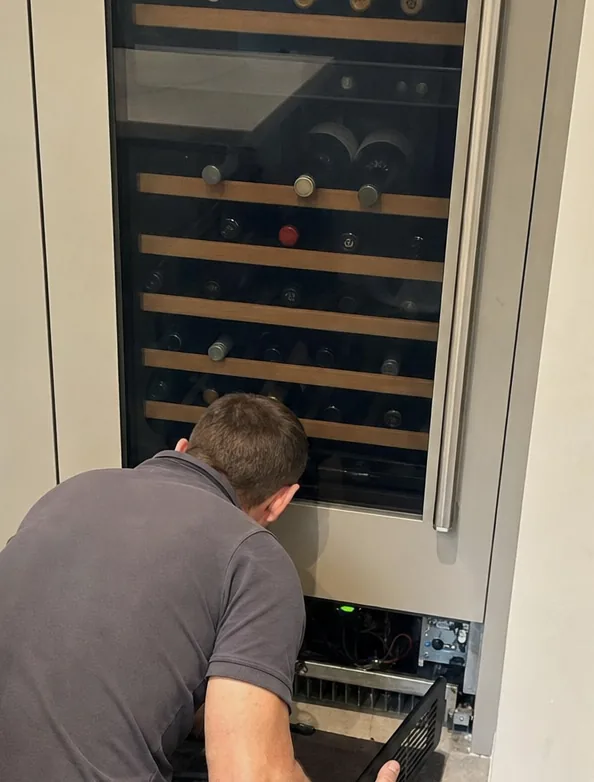
A refrigerator that fails tells on itself within a day. A wine unit does not. There is nothing in it that spoils visibly, the display keeps showing whatever it believes, and a cellar can sit several degrees off its set point for a season before anyone opens a bottle and finds out.
That is the reason we treat wine storage calls differently. The first job is not to find a broken part; it is to establish what the unit is actually doing.
Measure at the bottle, not at the panel
We take our own readings at bottle level in each zone. It is common to find a panel reporting a number that the cabinet is not achieving, and it is equally common to find a unit that is holding its average perfectly while swinging several degrees either side of it between cycles. Wine is more tolerant of a slightly wrong steady temperature than of a correct temperature that moves constantly, so the average alone does not tell you whether the unit is doing its job.
Stratification matters too. A dual-zone cabinet that reads correctly at the sensor but four degrees warmer at the top shelf has an airflow problem, not a control problem, and no amount of adjusting the set point will fix it.
Glass doors are the usual culprit
The door is heavier than a solid door and it is a far worse insulator. Two things follow from that.
First, the hinge takes more load, so a wine unit door drops out of alignment sooner than a refrigerator door does. A seal that is good along the top and open at the bottom corner is the classic finding.
Second, the glass is where condensation appears when the seal is compromised. People read the moisture on the inside of the door as a defect of the glass. It is almost always a seal admitting humid room air, which in this part of Florida is carrying a lot of water for most of the year.
Enclosed installations and heat
Undercounter wine units get built into joinery, and joinery gets built by people who are thinking about how the run looks rather than how the appliance breathes. We regularly find a grille partially blocked by a toe-kick detail, a cabinet return that lets the unit draw its own discharge air, or a unit installed next to a dishwasher that dumps heat and steam into the same cavity. In every one of those cases the refrigeration is fine and the installation is not.
Outdoor and garage installations add ambient heat that the unit has to fight all summer. A cabinet asked to hold cellar temperature in a Clay County garage in August is working at the edge of what it was built for, and it will show that as drift long before it shows it as a fault.
Condensers, again
As with every other unit in this catalogue, the condenser is on the list. It is worse on wine storage than on a kitchen built-in, because the unit is often lower down, closer to floor level, and pulling in exactly the dust and pet hair that collects there. In a household with a dog, an undercounter condenser can load up in a year.
What we are looking for instead, in order, is heat rejection, air movement, sealing and sensing. Those four account for nearly every wine-unit complaint we attend, and the first two are usually installation rather than appliance — a grille the joinery covered, or a cavity that lets the unit breathe its own warm discharge air back in.
The visit
Flat diagnostic fee, credited toward the repair, written estimate before any part is ordered. Refrigerant work is handled by EPA Section 608 certified technicians. If the answer is that the installation needs ventilation rather than the unit needing parts, that is what we will put in writing.
Where we take this call
What it costs
What does a wine storage repair cost?
The bands this fault lands in: $230 to $610, depending on which component it turns out to be.
$80 Flat $80 diagnostic covering the visit and the full diagnostic sequence, credited toward the repair once you approve the work.
| Repair | Typical range |
|---|---|
| Diagnostic visit | $80 flat, credited |
| Door gasket or seal replacement | $230–$610 |
90 days on labour, 365 days on parts, genuine oem parts. The whole table is on what it costs.
Asked on the phone
What else comes up on a wine storage call?
- Is a two-degree drift worth a service call?
- On wine storage, yes, because drift is the entire failure mode. There is no spoiled milk to warn you. A unit that has been running several degrees warm for a season has already done whatever it is going to do to the bottles, and the fault behind it rarely improves on its own.
- What does work on a wine cabinet cost?
- A sensor or thermostat fault sits at $260–$630, a fan at $260–$570, and zone control at $430–$810. Which of the three it is comes from reading both zones against our own probe rather than believing the panel, and the $80 diagnostic buys that reading either way.
- Does the unit have to come out of the cabinetry?
- Usually not. Most of what fails on wine storage is reachable from the front once the lower grille is off. A column that genuinely has to come out of its opening is the exception, and you are told about it before it happens rather than at the door.
Customer reviews
Owners who called about this
Chosen for this page because they describe the same fault, and printed in full.
4.44.4 out of 5 across all 63 reviews published on this site
4 out of 5
Condensation on the inside of the glass door and a set point that never matched reality. Seal and sensor both dealt with in the one visit, although I did wait a while for the appointment itself.
Roderick C.October 2025
3 out of 5
The wine unit holds temperature again, which is what I paid for. I was less impressed by how long the part took to arrive and by having to chase the booking for the second visit myself.
Thaddeus V.September 2025
5 out of 5
Quiet, careful and tidy in a kitchen full of glassware. The drift turned out to be a thermostat that was not closing at temperature, and he left the readings written down for us to keep.
Sibylla G.September 2025
All 63 of them, three-star entries included, are on what owners said after the visit.
Book a diagnostic visit
One flat fee to find out what is actually wrong, credited toward the repair. We cover Orange Park and the rest of Clay County within about 40 miles.
- Diagnostic
- $80
- Labour warranty
- 90 days
- Parts warranty
- 365 days
- Monday – Friday
- 08:00 – 18:00
- Saturday
- 09:00 – 16:00
Written estimate before any work starts. No parts ordered until you approve the figure. Closed Sunday. Calls placed after hours are returned the next working morning.