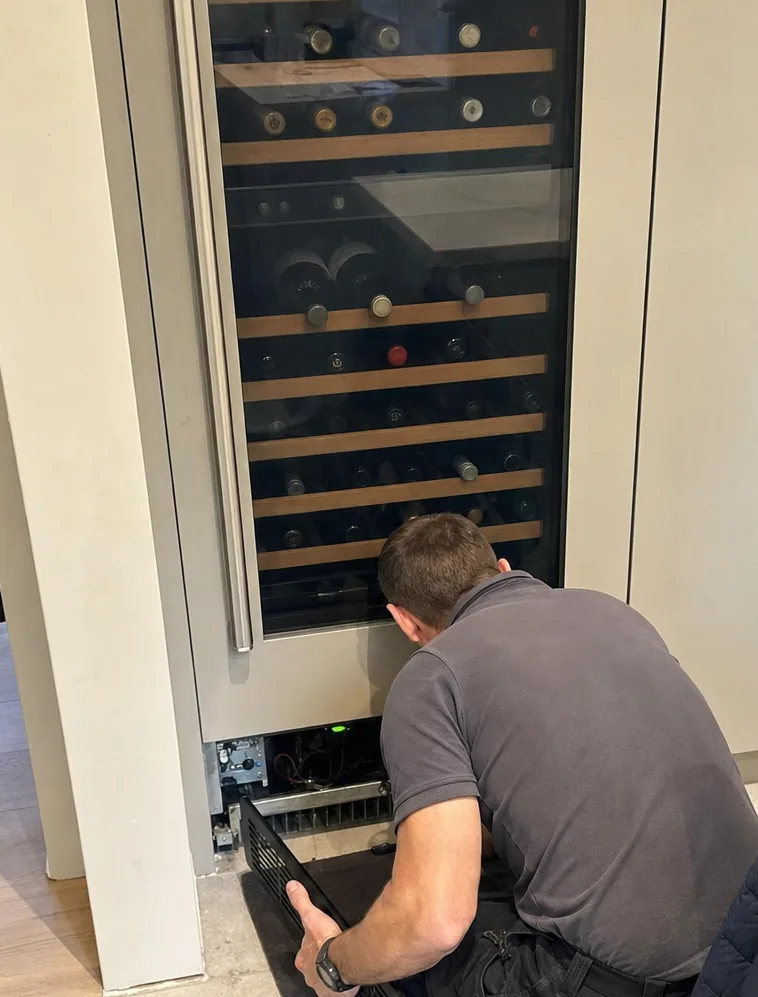
Somebody asks this on most visits, usually while we are writing the estimate, and the honest answer is that the arithmetic for a built-in is not the arithmetic for a freestanding refrigerator. It is worth explaining why, because the difference is large enough to change the decision.
Replacement is a joinery job
A freestanding unit is a purchase. You buy it, someone wheels the old one out and the new one in, and the job is done in an afternoon.
A built-in or a column is framed into cabinetry. Replacing it means matching the opening, and openings were built to the dimensions of what went into them. If the replacement is a different height, width or depth — and across a couple of decades of product generations, it very often is — then the surrounding cabinetry has to be modified, the trim has to be remade, and there is a real chance the countertop or the adjacent run is affected. The custom door panel almost never transfers.
None of that shows on the appliance price tag, and all of it lands on the same invoice as far as the household is concerned. In an Eagle Harbor or Pace Island kitchen where the refrigeration is integrated into a fitted run, the joinery can be a substantial fraction of the total. That is the single fact that moves the break-even point in favour of repair much further than people expect.
What we actually weigh
We are not going to give you a formula, because the honest version depends on the part. But here is how the categories sit.
Doors, gaskets, hinges and alignment. Almost always worth repairing, at any age. Cheap relative to everything else, and a badly sealing door is making every other fault worse while you deliberate.
Condenser cleaning and airflow. Worth doing regardless of what you decide afterwards, because it is inexpensive and because a unit you are thinking of keeping should not spend another summer overworking.
Defrost components and drains. Usually worth repairing. These are discrete parts with a clear failure and a clear fix, and success is not conditional on the rest of the machine being young.
Sensors, fans and low-voltage faults. Worth repairing. Small parts, bounded work.
Control boards. Depends on age and on what else is marginal. A board on an otherwise sound cabinet is usually worth it. A board on a unit that has already had a sealed-system repair and has a tired compressor is a harder conversation, and we will have it honestly.
Sealed-system work — leaks, restrictions, compressors. This is where the real judgement sits. It is the most expensive category, and it is the one where the age and history of the unit matter most. We will tell you plainly when we think it is the wrong money, and we would rather lose the job than take it.
The fifty per cent rule, and what it is for
Somebody always brings up the rule: replace when the repair costs more than half of a new one. It is a decent rule and it was written for a different machine.
Run it honestly here and the arithmetic mostly answers itself. The repair book on this page tops out at sealed-system work. The replacement side, in the second table, is the appliance alone — before delivery, before installation, before the panels and the trim a fitted opening needs, none of which appear on an appliance price tag. Half of the replacement figure is a line that almost nothing in the repair table reaches. On a freestanding unit the two columns are close enough for a percentage to decide it. On a built-in they are not in the same neighbourhood, which is why the rule quietly answers “repair” for a whole category of faults and why it is worth knowing that before somebody quotes it at you.
Where the rule earns its keep is at the top of the table. Sealed-system work is the one repair large enough for the comparison to be live, and even there the percentage is not what decides it — the history of the cabinet is.
Three ways this actually lands
Clearly worth repairing. Doors, seals, hinges and alignment. Condenser cleaning and airflow. Defrost components and drains. Fans, sensors and low-voltage faults. Every one of them sits in the lower half of the repair table, every one is a discrete part with a clear fix, and none of them depend on the rest of the machine being young. Age does not change this row.
A judgement call. Control boards, and sealed-system work on a cabinet with some history. The numbers still favour repair against the replacement table; what you are weighing is how much else in the machine is marginal. This is the conversation the written estimate exists for, and it is had with the readings on the paper.
Not worth it. A sealed system that has already been opened and has failed again. Several unrelated faults inside a year on a cabinet whose doors and structure are also going. Physical damage to the cabinet itself. We will say so on the day, and the flat diagnostic is what makes that sayable — there is no repair to justify the visit against afterwards.
Age is a weaker signal than people think
“It is twenty years old” is not, by itself, an argument for replacement. Built-in refrigeration was engineered on the assumption of a long service life, and the components that fail first are largely the serviceable ones. A well-maintained twenty-year-old cabinet with a fouled condenser and a tired gasket is a good repair. A poorly maintained ten-year-old one that has been running at high head pressure for years is a worse one.
What we look at instead is the history: has the sealed system already been opened, how many separate faults have appeared in the last three years, is the compartment achieving its set point when everything else is right, and what condition the cabinet and doors are physically in.
What we will not do
We do not have replacement units to sell you, which removes the obvious conflict of interest. We also will not quote a repair we do not believe in to keep a job alive. The written estimate you get says what the fault is, what it costs, and — when it is relevant — that we think you should spend the money elsewhere.