Sub-Zero refrigeration
A Sub-Zero ice maker that has stopped, from Eagle Harbor to Doctors Lake
The most common call we take, and the one most often misdiagnosed. An ice maker that will not harvest is frequently reporting a fault somewhere else in the cabinet.
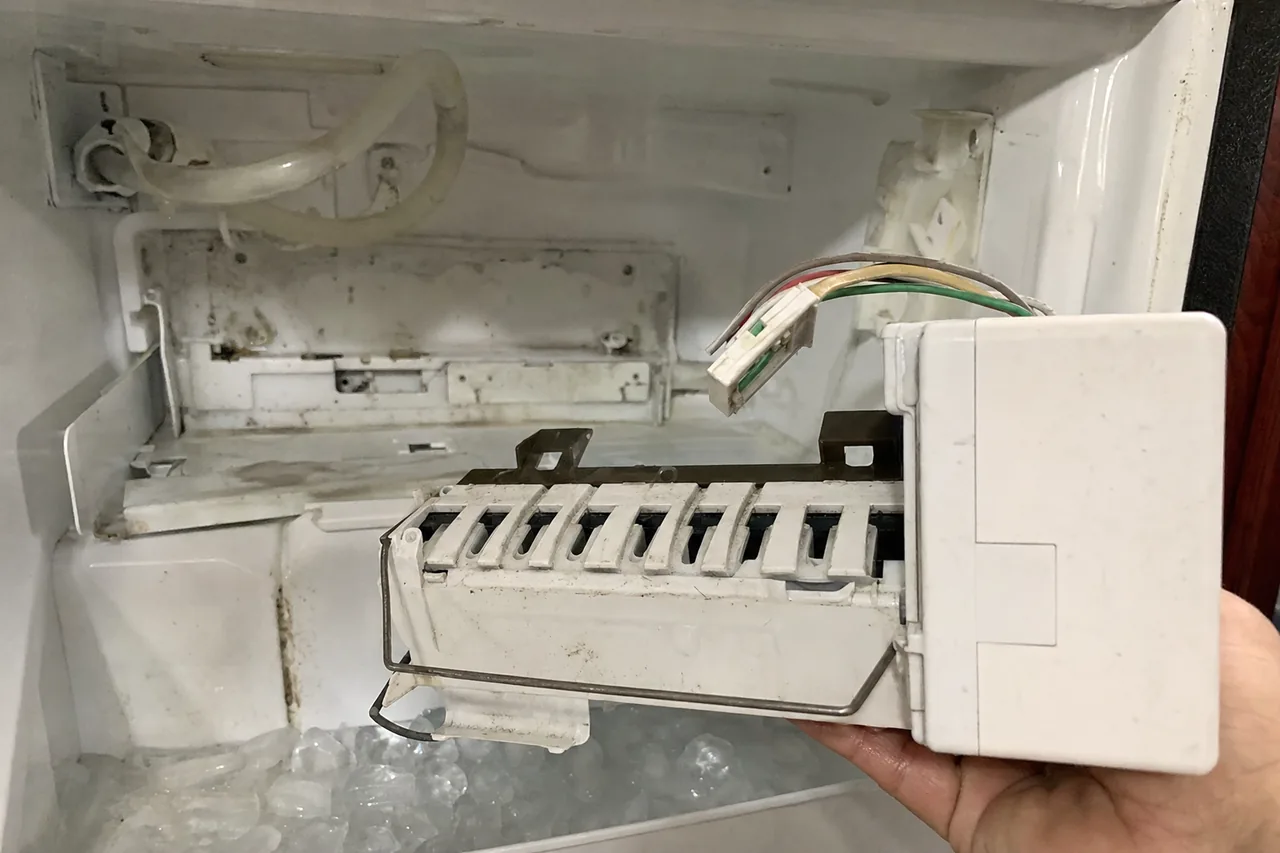
An ice maker that has stopped is the call we take most often, and it almost always arrives with a theory already attached: the ice maker is broken and it needs a new one.
Sometimes that is right. More often the ice maker is the messenger rather than the fault. It is the most temperature-sensitive process in the cabinet, because it will not begin a harvest until the mold reaches its release temperature, so it is the first thing to visibly stop when something upstream of it drifts. Fitting a new assembly on suspicion buys a new part and the same symptom — which is why the compartment gets checked before the ice maker does.
Temperature comes before the ice maker
The freezer compartment gets measured before anything is opened up. A compartment sitting a few degrees warmer than it should produces exactly the symptom described on the phone: the mold fills, the water freezes eventually, and nothing ever comes out of it. That is a refrigeration fault showing up in the ice first, and a new assembly fitted into it produces the same result as the old one.
On a built-in with two sealed systems, the freezer side can be struggling while the fresh-food side reads perfectly normal, which is why so many people tell us “the fridge is fine, it is just the ice.” Often the fridge is fine. The other half of the machine is not.
Fill, freeze, harvest, drain
Once temperature is confirmed, the sequence has four stages and the cube itself tells you which one failed.
Fill. Hollow cubes, short cubes, or a mold that is only part full point at water delivery: a partially closed shut-off behind the cabinet, a filter that was last changed several years ago, a kinked line pushed against the wall when the unit was slid back in, or a fill valve that is opening but not passing its rated flow. We check pressure at the shut-off as well as at the appliance, because a restriction upstream reads the same as a failed valve if you only measure in one place.
Freeze. Cubes that are cloudy or take far too long point back at compartment temperature and, behind that, at airflow.
Harvest. A full, properly frozen mold that never ejects is a mold heater or ejector problem. This is the one stage where the ice maker itself is genuinely at fault, and it is a smaller share of these calls than most people expect.
Drain. A solid slab in the bin is not an ice-maker failure at all. It is melt-and-refreeze, and it means something is warming the bin between cycles — usually a defrost or drain issue, sometimes a door that is not sealing.
The condenser question
Before we leave, the condenser gets looked at whatever the fault turns out to be. In a house with dogs, cats, or an air handler running nine months of the year, the condenser behind the upper grille collects a felt of hair and dust that it was never designed to breathe through. The unit compensates quietly for months. Then it stops compensating, and the ice is the first thing you notice.
When the assembly really is the answer
There is a version of this call where the ice maker itself is genuinely at fault, and it is worth describing so the estimate makes sense when you see it. A mold that fills correctly, freezes to a proper cube in a compartment we have measured and confirmed, and then never ejects has a harvest problem: the mold heater, the ejector mechanism, or the switch that tells the control the cycle finished.
That is a bounded repair on a discrete part, and it is the one situation where replacing the assembly is the cheapest correct answer rather than a guess. The part is ordered against the model and serial from the plate inside the cabinet, because components are revised within a model designation and two units that look identical in a kitchen can take different assemblies. Common wear items ride on the van; an assembly ordered to a serial number adds days rather than hours, and we tell you which of the two you are in before you commit.
One honest limit: if the supply into the house is the problem — a failed shut-off, house plumbing, or a filter housing that is not ours — we will say so and stop there rather than working outside what we are competent to touch.
What a visit costs
The flat diagnostic covers the visit and is credited toward the repair if you go ahead with it. You get a written figure before any part is ordered. Refrigerant work is handled by EPA Section 608 certified technicians, and parts are genuine OEM.
Where we take this call
What it costs
What does a ice maker repair cost?
The bands this fault lands in: $240 to $2,460, depending on which component it turns out to be.
$80 Flat $80 diagnostic covering the visit and the full diagnostic sequence, credited toward the repair once you approve the work.
| Repair | Typical range |
|---|---|
| Diagnostic visit | $80 flat, credited |
| Ice maker, water valve or supply line | $240–$620 |
| Compressor or sealed-system repair | $950–$2,460 |
90 days on labour, 365 days on parts, genuine oem parts. The whole table is on what it costs.
Asked on the phone
What else comes up on a ice maker call?
- Is a dead ice maker usually the ice maker?
- Often not. Ice is the most temperature-sensitive process in the cabinet, so it is the first thing to stop when the freezer is drifting a couple of degrees for some other reason. The compartment gets read before the module comes out, which is what keeps a working part from being replaced.
- What does an ice-maker repair cost?
- The ice maker, water valve and supply line band runs $240–$620, parts and labour together, and the $80 diagnostic comes off it when you go ahead. If the module turns out to be reporting a defrost or airflow fault rather than failing itself, the figure follows that fault instead.
- Why are the cubes hollow or half the usual size?
- That is a water-side answer far more often than a module one: a restricted supply line, a valve not opening fully, or a harvest completing before the mold has filled. Worth saying on the phone, because it changes what rides on the van for your visit.
Customer reviews
Owners who called about this
Chosen for this page because they describe the same fault, and printed in full.
4.44.4 out of 5 across all 63 reviews published on this site
5 out of 5
I was certain the ice maker was finished. It turned out the bin kept warming between harvests because the freezer drawer was not closing squarely. He fixed the drawer and left the module alone.
Octavian H.June 2026
4 out of 5
Good work and a careful explanation of why the slab in the bin was not an ice fault at all. The only frustration was waiting for a valve to arrive, which he did warn me about at the first visit.
Beatrix N.June 2026
5 out of 5
Water was reaching the mold in dribbles. He checked pressure at the shut-off as well as at the appliance, which nobody else had done, and the restriction turned out to be upstream of the cabinet entirely.
Lysander C.May 2026
All 63 of them, three-star entries included, are on what owners said after the visit.
Book a diagnostic visit
One flat fee to find out what is actually wrong, credited toward the repair. We cover Orange Park and the rest of Clay County within about 40 miles.
- Diagnostic
- $80
- Labour warranty
- 90 days
- Parts warranty
- 365 days
- Monday – Friday
- 08:00 – 18:00
- Saturday
- 09:00 – 16:00
Written estimate before any work starts. No parts ordered until you approve the figure. Closed Sunday. Calls placed after hours are returned the next working morning.